
Flower Seed Germination Temperature Chart: The Complete Guide for Home & Commercial Growers
Share
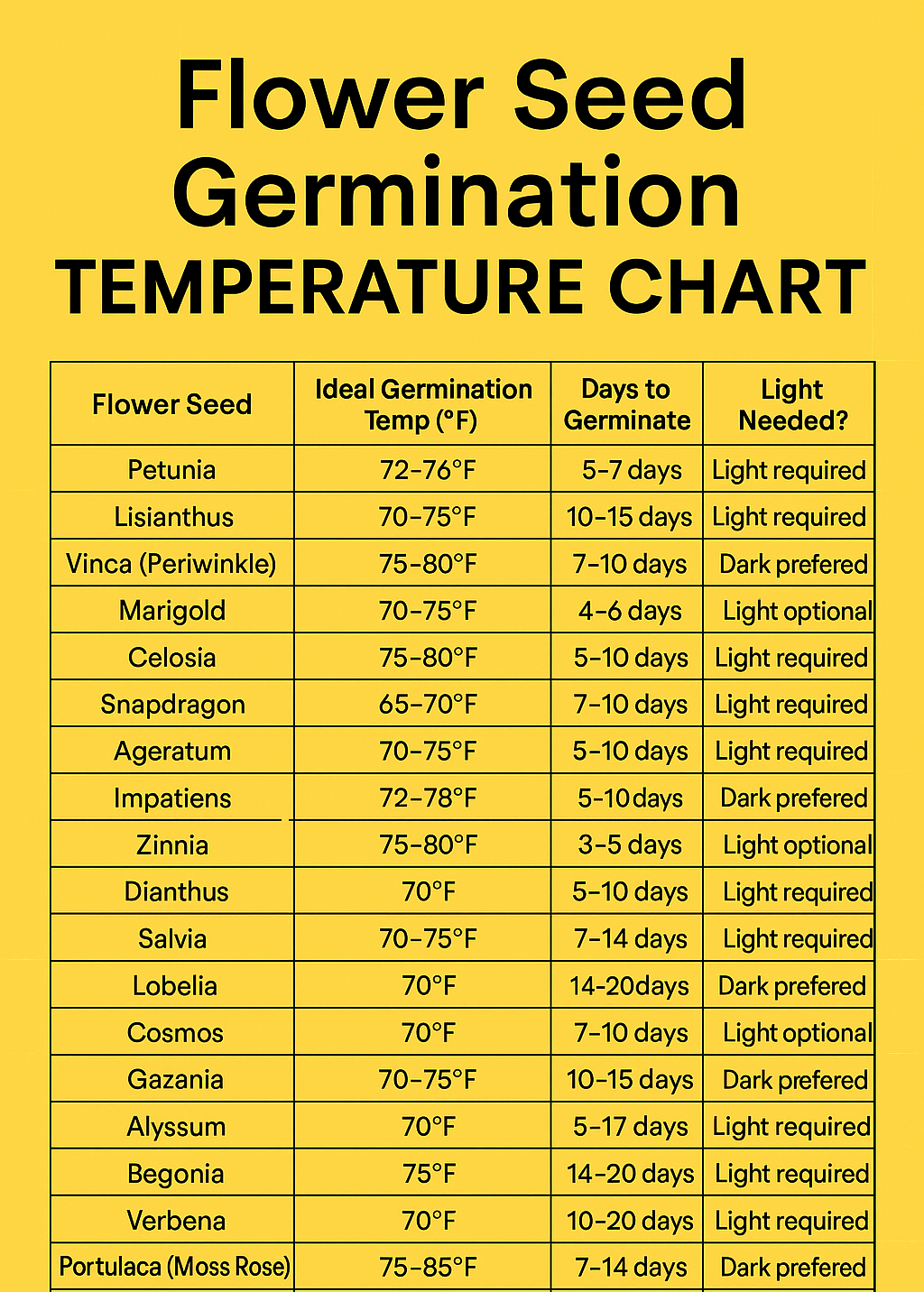
Getting flower seeds to sprout evenly and quickly often comes down to one key factor — temperature. Each variety has its own ideal germination range, and mastering this can mean the difference between a flat tray of strong seedlings and uneven, delayed growth.
This complete Flower Seed Germination Temperature Chart is built for both home gardeners and commercial growers. It covers the best temperatures, germination times, and light needs for over 30 popular flower crops — with professional growing insights you can trust.
🌡️ Why Germination Temperature Matters
Seeds respond to warmth, moisture, and oxygen. Too cool, and they sit dormant; too hot, and they lose vigor. Maintaining consistent warmth — usually between 65°F and 75°F (18°C–24°C) — jumpstarts enzyme activity and uniform sprouting.
For commercial growers, precision germination can mean better plug tray uniformity, fewer culls, and stronger transplants ready for retail earlier. For home growers, it means less guessing and more success from every seed packet.
🔥 The Complete Flower Seed Germination Temperature Chart
| Flower Seed | Ideal Germination Temp (°F) | Days to Germinate | Light Needed? |
|---|---|---|---|
| Petunia | 72–76°F | 5–7 days | Light required |
| Lisianthus | 70–75°F | 10–15 days | Light required |
| Vinca (Periwinkle) | 75–80°F | 7–10 days | Dark preferred |
| Marigold | 70–75°F | 4–6 days | Light optional |
| Celosia | 75–80°F | 5–10 days | Light required |
| Snapdragon | 65–70°F | 7–10 days | Light required |
| Ageratum | 70–75°F | 5–10 days | Light required |
| Impatiens | 72–78°F | 10–20 days | Light required |
| Zinnia | 75–80°F | 3–5 days | Dark preferred |
| Dianthus | 70°F | 5–10 days | Light optional |
| Salvia | 70–75°F | 7–14 days | Light required |
| Lobelia | 70°F | 14–20 days | Light required |
| Cosmos | 70–75°F | 7–10 days | Light optional |
| Gazania | 70–75°F | 10–15 days | Dark preferred |
| Alyssum | 70°F | 5–7 days | Light required |
| Begonia | 75°F | 14–20 days | Light required |
| Verbena | 70°F | 10–20 days | Light optional |
| Portulaca (Moss Rose) | 75–85°F | 7–14 days | Light required |
| Delphinium | 60–65°F | 10–20 days | Dark preferred |
| Lupine | 65–70°F | 14–20 days | Dark preferred |
| Gerbera Daisy | 75°F | 10–14 days | Light required |
(For professional plug production, aim for consistent soil temperature rather than ambient air temperature — bottom heat mats work best.)
💧 Grower’s Tips for Reliable Germination
-
Use a humidity dome until seedlings emerge, then remove immediately to prevent damping off.
-
Keep media evenly moist, not saturated — oxygen flow is key.
-
Use fine vermiculite or light dusting of media over seeds that require darkness.
-
Pre-soak slow species like Lupine or Delphinium for faster uptake.
-
Light matters: always check your variety’s light requirements before covering.
🌼 Popular Varieties to Explore
Discover high-quality seeds for these varieties on both of our seed sites:
-
Lisianthus Seeds: Bulk Lisianthus Packs → | Smaller Lisianthus Packs →
-
Vinca Seeds: Bulk Vinca Packs → | Smaller Vinca Packs →
-
Marigold Seeds: Bulk Marigold Packs → | Smaller Marigold Packs →
-
Celosia Seeds: Bulk Celosia Packs → | Smaller Celosia Packs →
-
Snapdragon Seeds: Bulk Snapdragon Packs → | Smaller Snapdragon Packs →
-
Petunia Seeds: Bulk Petunia Packs → | Smaller Petunia Packs →
🌿 Related Reading
🌾 Where to Buy
-
🌱 Bulk Site All Packs: https://www.trailingpetuniabulkseeds.com/
-
🌸 Smaller Packs All Seeds: https://www.trailingpetunia.com/
❓ FAQ Section
Q1: Why do my flower seeds take so long to sprout?
Many flower seeds, especially Lisianthus and Begonia, need steady warmth and light to trigger germination. Keep them consistently warm — not fluctuating — for reliable results.
Q2: Can I use a heat mat for all flower seeds?
Yes, but monitor temperature carefully. Most germinate best between 70–75°F. Heat mats speed up germination but remove once seedlings emerge to prevent stretching.
Q3: What happens if it’s too cold?
Cold slows metabolic activity, delaying or even stopping germination. Petunias, Vincas, and Celosia may fail completely if soil temps drop below 65°F.
Q4: Should I cover my flower seeds with soil?
That depends on light needs. Petunia, Lisianthus, and Celosia need light — sow on the surface. Vinca, Delphinium, and Lupine prefer darkness and light covering.
Q5: How long will the chart stay accurate?
These values are stable across seed generations and growing zones. Always check for specific series (e.g., Vinca Tattoo™, Petunia Easy Wave®) for refined temperature preferences.